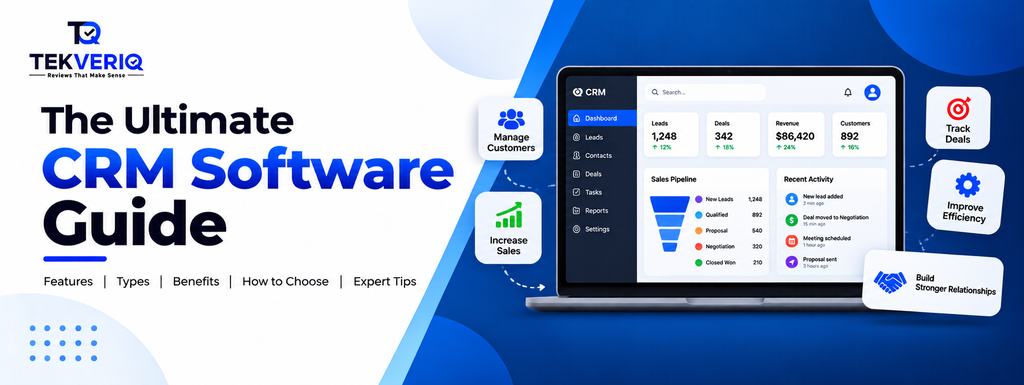
In today’s fast-paced digital market, managing client relationships efficiently could make or spoil a business organization. Gone are the days of monitoring leads on sticky notes, scattered spreadsheets, or overflowing email inboxes. As your customer base grows, keeping track of every interaction, follow-up, and sale manually becomes nearly impossible.
This is where a Customer Relationship Management (CRM) software steps in as a game-changer. A strong CRM does a great deal more than store contact information; it centralizes your customer information, automates repetitive sales and marketing responsibilities, and provides deep insights to help your team close deals faster. Whether you’re a small startup seeking to convert your first hundred leads or a longtime agency aiming to streamline complex earnings pipelines, selecting the right CRM is the final catalyst for sustainable growth.
In this complete manual, we can walk you through everything you want to know about CRM software in 2026, key capabilities to look for, top market contenders, and a step-by-step framework to help you choose the correct platform for your business needs.
Why Your Business Needs a CRM
Many developing organizations make the error of counting on spreadsheets, email folders, and memory to manage their client interactions. While this could work when you have a handful of customers, it quickly results in neglected follow-ups, lost leads, and frustrated clients as your business scales.
Investing in a CRM software transforms how your group operates by bringing organization, automation, and clarity to your complete sales lifecycle. Here are the main reasons why your enterprise needs a CRM right now:
- Centralized Customer Data: Say goodbye to scattered notes and misplaced touch details. A CRM stores each customer’s phone number, email, purchase history, past conversations, and notes in a unified, central dashboard available to your entire team.
- Automated Sales Pipelines: Eliminate tedious guide duties like data access, scheduling follow-up emails, and updating lead statuses. Automation tools take care of these routines so your sales reps can focus on what they do best, building relationships and closing deals.
- Enhanced Team Collaboration: When multiple group contributors are interacting with the same client, miscommunication can occur. A CRM guarantees everyone is on the same page through tracking who spoke with the purchaser last, what was mentioned, and what the next step is.
- Data-Driven Decision Making: Stop guessing what works. Built-in analytics and reporting tools provide real-time visibility into sales performance, team productivity, conversion rates, and sales forecasts, supporting you in making smarter business moves.
- Improved Customer Retention: Satisfied customers are loyal customers. With computerized reminders for take-a-look-ins, customized communication, and quicker question resolutions, a CRM helps you deliver an outstanding customer experience from day one.
In short, a CRM isn’t always just a rate; it’s a growth engine that saves time, reduces human mistakes, and immediately drives higher income sales.
Key Features to Look For in CRM Software
With masses of CRM platforms on the market, choosing the right option can be overwhelming. Not all equipment is created equal, and deciding to buy features your team will never use is a waste of money.
When evaluating CRM software, search for these important core features that immediately affect productivity, sales speed, and customer satisfaction:
- Centralized Contact & Lead Management: The basis of any excellent CRM is a unified database. It has to capture and organize every lead’s contact info, records of interactions, past purchases, and notes in a single searchable location. Advanced systems also provide lead scoring, automatically prioritizing prospects who show high buying intent so your group focuses on the best opportunities first.
- Visual Sales Pipeline Management: Say goodbye to guesswork. A modern CRM affords a Kanban-style, drag-and-drop visible pipeline view. This will help your group right away track every deal from initial contact through negotiation to closed-won, helping you see pipeline bottlenecks and forecast future revenue accurately.
- Intelligent Workflow Automation: Repetitive administrative duties kill crew productivity. Look for features that automate habitual workflows, including assigning incoming leads to the right reps, triggering instant follow-up emails, scheduling calendar reminders, and updating deal statuses without manual data entry.
- Email & Calendar Integration: A pinnacle-tier CRM seamlessly syncs with your daily equipment (like Gmail, Outlook, Google Calendar, or Microsoft 365). Two-way sync ensures that each email sent or received is automatically logged into the patron’s profile, stopping duplicate entries and missed updates.
- AI-Powered Insights and Analytics: Modern CRMs leverage artificial intelligence to provide predictive sales forecasting, smart suggestions, and sentiment analysis. Real-time dashboards provide visibility into overall team performance, conversion rates, and sales trends immediately, empowering you to make fact-based business decisions.
- Mobile Accessibility: Business doesn’t best occur behind a desk. A responsive mobile app (for iOS and Android) is vital for remote teams or subject dealers, letting them log calls, update offers, check customer info, and respond to inquiries on the go.
- Seamless Third-Party Integrations: Your CRM should by no means perform in isolation. Ensure the software connects with your website infrastructure, accounting software, customer support software, and advertising and marketing automation platforms to create a unified business environment.
By focusing on those key competencies, you may pick a platform that fits seamlessly into your day-to-day operations and scales effectively as your enterprise grows.
Top CRM Software Comparison
| CRM Software | Best Suited For | Key Standout Features | Pricing (Starting From) | Pros | Cons |
|---|---|---|---|---|---|
| HubSpot CRM | Small to mid-sized businesses, startups, and marketing-heavy teams | All-in-one suite (Marketing, Sales, Service), intuitive interface, great free tier | Free tier available; Paid plans start around $20–$50/user/month | Very user-friendly, excellent free plan, seamless inbound marketing tools | Can get expensive quickly as you scale and add advanced features |
| Salesforce | Enterprise businesses and large, complex sales operations | Highly customizable, massive app ecosystem (AppExchange), advanced AI (Einstein) | Starts around $25–$75+/user/month (Professional/Enterprise tiers higher) | Extremely powerful, infinite scalability, robust reporting and integrations | Steep learning curve, expensive setup and maintenance costs |
| Zoho CRM | Small businesses and budget-conscious teams looking for high value | Affordable pricing, strong multi-channel support (social, phone, email), built-in AI assistant (Zia) | Free tier available; Paid plans start around $14–$23/user/month | Feature-packed for the price, excellent automation capabilities | User interface can feel cluttered and less modern compared to competitors |
| Pipedrive | Sales-focused teams and small businesses | Visual drag-and-drop pipeline, activity-based selling, easy setup | Starts around $14–$24/user/month | Very easy to use, keeps teams focused on actionable tasks, great mobile app | Lacks native robust marketing or customer support automation tools |
| Freshsales | Growing businesses wanting built-in telephony and AI features | Built-in phone/email, Freddy AI for deal insights, visual pipeline management | Free tier available; Paid plans start around $9–$15/user/month | Excellent built-in communication features (phone/email), great value | Customization options are somewhat limited compared to enterprise giants |
How to Choose the Right CRM
- Define Your Goals: Identify your major bottleneck (e.G., misplaced leads or terrible monitoring) to pick out a device that solves it.
- Check Team Usability: Ensure the platform is user-friendly so your team clearly adopts it every day.
- Verify Integrations: Confirm it connects easily with your email, website, office work, and current gear.
- Calculate Total Cost: Look beyond the lowest price to check for hidden setup, training, or scaling charges.
- Test Before Buying: Use free trials or demos to allow your team to check the workflow firsthand.
Conclusion
Implementing the proper CRM software is no longer optional for groups looking to scale in 2026—it is a central necessity. By centralizing patron information, automating tedious pipelines, and imparting actionable insights, a modern-day CRM transforms how your group sells and connects with clients.
Whether you choose the user-friendly approach of HubSpot, the revenue focus of Pipedrive, or the power of Salesforce, success comes down to choosing a platform that aligns with your precise workflow and price range. Start by defining your needs, trying out some free trials, and taking that important step toward smarter, automated growth.